
核融合・エネルギー · 研究プレプリント
トリチウムの初期供給と継続供給
燃料サイクルの余裕と顧客別の供給コミットメント
Start-Up or Sustained Supply?
Tritium Fuel-Cycle Margins and Customer Commitments
上の日本語題は本サイトの紹介題です。引用には下記の原題を使用してください。
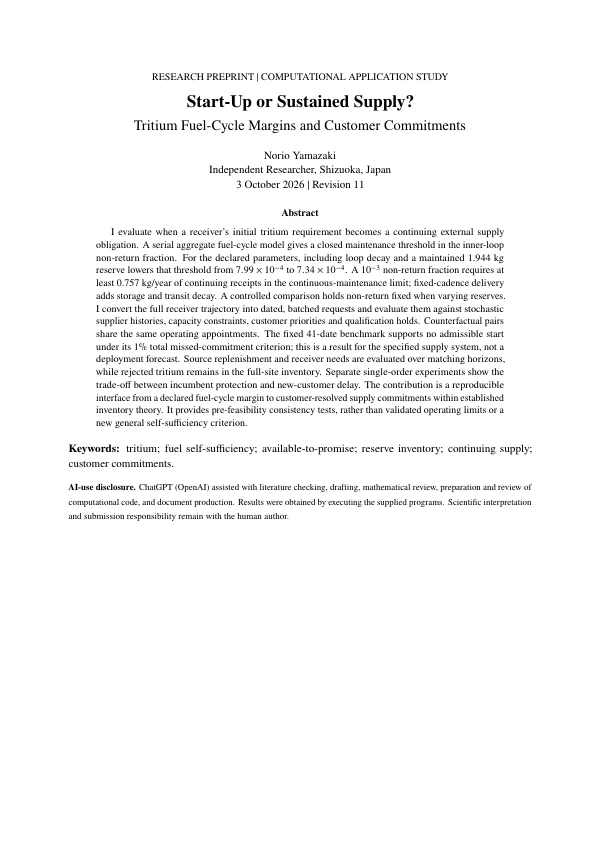 紹介に用いた原稿の表題ページ
研究の概要
核融合炉のトリチウム需要が起動時だけで済むのか、継続的な外部供給を要するのかを、宣言した燃料サイクルモデルで検討します。受入側の需要を日付と数量を持つ要求へ変換し、供給能力と既存顧客への約束との関係を分析します。
THE RESEARCH QUESTION
初期在庫として見積もった供給が、どの条件で継続的な外部供給義務となり、供給者の顧客別コミットメントにどう影響するか。
分析方法
集約型の燃料サイクルモデルと既存の在庫理論を接続した計算研究です。減衰、循環、備蓄、非帰還割合から受入側の全需要軌跡を求め、確率的な供給履歴、能力制約、顧客優先順位、適格性の保留を用いて評価します。比較の反実仮想は同じ運転予定を共有します。
本稿の主張・計算結果
- 宣言した条件で、ループ内減衰と維持する1.944 kgの備蓄を含めると、内側ループの非帰還割合の維持閾値が7.99×10⁻⁴から7.34×10⁻⁴へ下がります。
- 非帰還割合10⁻³の条件では、連続維持の極限で少なくとも0.757 kg/年の継続受入れが必要となります。定間隔の配送には保管・輸送時の減衰が追加されます。
- 設定した41日付のベンチマークでは、未履行コミットメント総計1%の基準に適合する開始を支持できませんでした。これは特定の供給システムについての計算結果です。
出典:紹介に用いた研究原稿。PDF 1ページ(表題・版・日付・要旨)、2ページ(導入・モデルの位置づけ)。以下は著者の議論・設定条件下の分析を紹介したもので、第三者による検証や採択の認定ではありません。
研究の射程と留保
- 計算の再現は、実設備の運用限界や燃料自給の実証を意味しません。実際の配備時期を予測する研究でもありません。
- 備蓄1.944 kgは明示した混合パラメータによる条件設定です。普遍的な炉型の備蓄要件として引用できません。
- 既存の在庫理論を用いた計算応用であり、新しい一般的なATPアルゴリズムや燃料自給基準の確立は主張しません。
Original abstract(英語)
I evaluate when a receiver’s initial tritium requirement becomes a continuing external supply obligation. A serial aggregate fuel-cycle model gives a closed maintenance threshold in the inner-loop non-return fraction. For the declared parameters, including loop decay and a maintained 1.944 kg reserve lowers that threshold from 7.99 × 10⁻⁴ to 7.34 × 10⁻⁴. A 10⁻³ non-return fraction requires at least 0.757 kg/year of continuing receipts in the continuous-maintenance limit; fixed-cadence delivery adds storage and transit decay. A controlled comparison holds non-return fixed when varying reserves. I convert the full receiver trajectory into dated, batched requests and evaluate them against stochastic supplier histories, capacity constraints, customer priorities and qualification holds. Counterfactual pairs share the same operating appointments. The fixed 41-date benchmark supports no admissible start under its 1% total missed-commitment criterion; this is a result for the specified supply system, not a deployment forecast. Source replenishment and receiver needs are evaluated over matching horizons, while rejected tritium remains in the full-site inventory. Separate single-order experiments show the trade-off between incumbent protection and new-customer delay. The contribution is a reproducible interface from a declared fuel-cycle margin to customer-resolved supply commitments within established inventory theory. It provides pre-feasibility consistency tests, rather than validated operating limits or a new general self-sufficiency criterion.
引用情報
Yamazaki, Norio. (2026-10-03). Start-Up or Sustained Supply? Tritium Fuel-Cycle Margins and Customer Commitments. Revision 11. 研究プレプリント.
原稿日付はPDFの表題ページの記載です。リポジトリへの初回掲載日とは区別してください。紹介内容の確認日:2026.10.09。