Tritium Fuel-Cycle Margins and Customer Commitments
上の日本語題は本サイトの紹介題です。引用には下記の原題を使用してください。
山崎哲央 / Norio Yamazaki原稿日付 Revision 11
トリチウム燃料自給ATP備蓄在庫継続供給顧客コミットメント
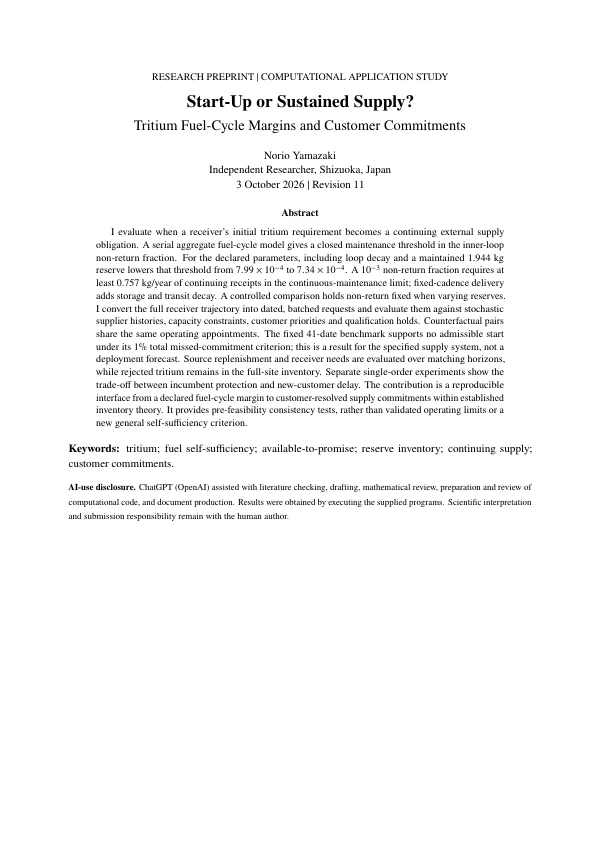
紹介に用いた原稿の表題ページ
原文要旨 / Original abstract(英語)
I evaluate when a receiver’s initial tritium requirement becomes a continuing external supply obligation. A serial aggregate fuel-cycle model gives a closed maintenance threshold in the inner-loop non-return fraction. For the declared parameters, including loop decay and a maintained 1.944 kg reserve lowers that threshold from 7.99 × 10⁻⁴ to 7.34 × 10⁻⁴. A 10⁻³ non-return fraction requires at least 0.757 kg/year of continuing receipts in the continuous-maintenance limit; fixed-cadence delivery adds storage and transit decay. A controlled comparison holds non-return fixed when varying reserves. I convert the full receiver trajectory into dated, batched requests and evaluate them against stochastic supplier histories, capacity constraints, customer priorities and qualification holds. Counterfactual pairs share the same operating appointments. The fixed 41-date benchmark supports no admissible start under its 1% total missed-commitment criterion; this is a result for the specified supply system, not a deployment forecast. Source replenishment and receiver needs are evaluated over matching horizons, while rejected tritium remains in the full-site inventory. Separate single-order experiments show the trade-off between incumbent protection and new-customer delay. The contribution is a reproducible interface from a declared fuel-cycle margin to customer-resolved supply commitments within established inventory theory. It provides pre-feasibility consistency tests, rather than validated operating limits or a new general self-sufficiency criterion.
Using a declared fuel-cycle model, this preprint examines when a start-up tritium requirement becomes a continuing need for external supply. It converts receiving-side demand into dated quantity requirements and analyses their relationship with supply capacity and commitments to existing customers.

 紹介に用いた原稿の表題ページ