Receipt of Manifestations of Intention in Asynchronous Messaging
Attribution of Receiving Functions, Failure Histories, and Electronic Evidence under Article 97 of the Japanese Civil Code
山崎哲央 / Norio Yamazaki原稿日付 Version 36
民法97条意思表示の到達通知リスク非同期メッセージング障害履歴電子的証拠
紹介に用いた原稿の表題ページ
原文要旨 / Original abstract(英語)
When a recipient-side provider accepts a notice but a failure occurs before its contents become retrievable, who bears the risk of delay or non-receipt? Focusing on email and HTTP-based notices, with a functional comparison to queue-based receipt, this article distinguishes provider selection, protocol-level acceptance, attribution of receiving functions, and the recipient's opportunity to retrieve a particular notice. It proposes that, ordinarily under Article 97(1), risk shifts when a receiving route attributable to the recipient has been established and the particular notice's existence, originator, and legally material contents can be objectively identified and understood through that route. This objective retrievability is not a new statutory requirement of a search index or a particular user interface. It operationalizes the established formulation of a state in which cognition is possible by asking whether an existing function permits the particular notice to be distinguished and its contents encountered. Designation and a positive acknowledgement can support an inference of receipt, but their significance depends on the receiving role and the event acknowledged. Where P is an authorized recipient agent, the analysis separates receipt by P under Article 97, attribution to B under Article 99(2), and the relevant person's knowledge or negligence under Article 101(2); Article 101(3) does not automatically apply to passive receipt alone. The article also specifies the alternative pleading structures for Article 97(2) and tests timing clauses under Articles 548-2 to 548-4 and, where relevant, Articles 8 and 10 of the Consumer Contract Act. The analysis has two stages: establishment of a recipient-attributable receiving route, followed by objective retrievability. Neither the two stages nor the technical states are proposed as independent cumulative elements added to Article 97. The article expressly separates statutory operative facts, facts supporting or permitting an inference of satisfaction of an element, materials for contractual interpretation, evidence used to test causation, and policy proposals. It distinguishes durable storage, recipient assignment, enumeration or search, authorization and decryption, retrieval, and subsequent processing without treating them as a universal sequence or making durability an independent legal requirement. Controlled hypotheticals show how identical sender-visible records can coexist with different legally relevant histories. The evidentiary analysis separates the burden of proof, factual inferences, production of records, and obstruction of proof, as well as the time of legal receipt from an evidentially established time interval. The contribution is an operational specification of existing receipt doctrine through functional attribution, failure histories, and evidence mapping. Foreign judgments and international instruments provide functional reference points; the article does not claim empirical validation or an exhaustive comparative study.
This manuscript examines legal receipt when a sender obtains an acceptance response but the recipient cannot access the particular notification. It develops an interpretation of Article 97 of the Japanese Civil Code through attribution of receiving functions, failure histories, and the relationship between technical events and electronic evidence.
Yamazaki, Norio. (2026-09-13). Receipt of Manifestations of Intention in Asynchronous Messaging Attribution of Receiving Functions, Failure Histories, and Electronic Evidence under Article 97 of the Japanese Civil Code. Version 36. 投稿準備稿. https://papers.ssrn.com/sol3/papers.cfm?abstract_id=7437198

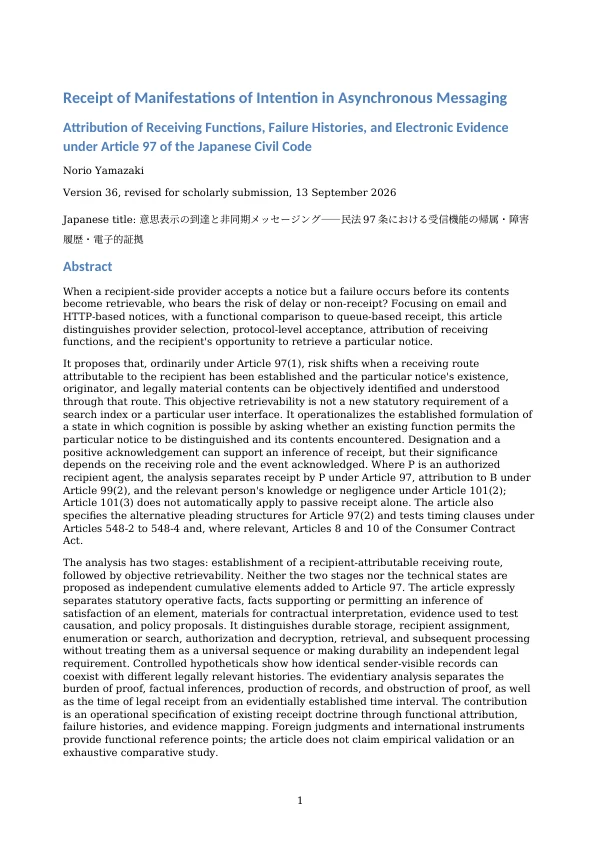 紹介に用いた原稿の表題ページ