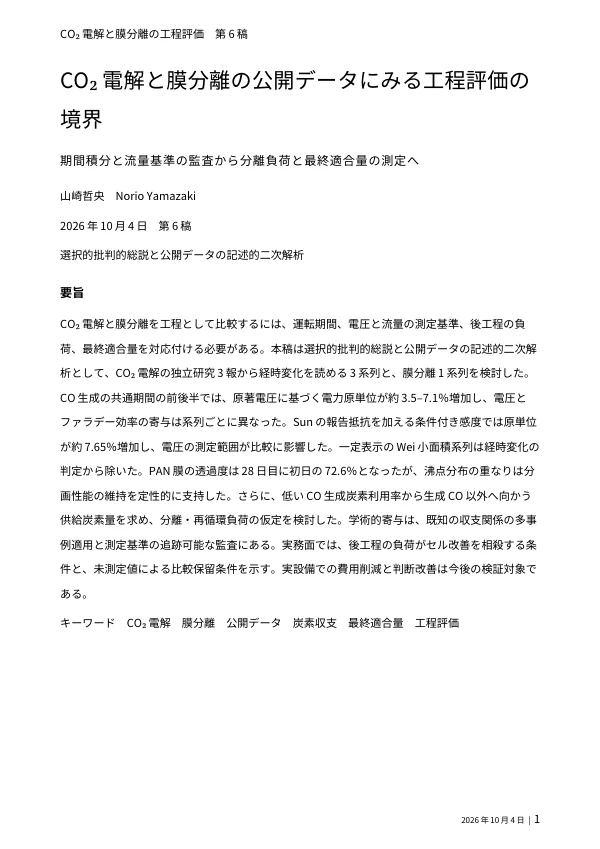
Comparing CO₂ electrolysis and membrane separation requires consistent observation periods, voltage and gas-flow bases, downstream loads and final conforming output. This selective critical review and descriptive secondary analysis examines three informative CO-producing durability traces from three independent reports and one membrane-permeance trace. Published-voltage electricity intensities increase by approximately 3.5–7.1% between the two halves of a common observation window, with different voltage and Faradaic-efficiency contributions. Conditionally adding Sun’s reported external resistance increases its intensity by approximately 7.65%, illustrating the effect of voltage boundaries. The constant-display small-area Wei trace is excluded from temporal-change evidence. PAN membrane permeance reaches 72.6% of the first-day value on day 28, while overlapping boiling-point distributions qualitatively support maintained fractionation. A feed-carbon balance further connects low CO utilization to conditional separation and recycle loads without double counting anode carbon transfer. The academic contribution is a traceable multi-case application of established balances and an audit of measurement bases. Practical results include downstream-load break-even conditions and explicit comparison holds for missing inputs. Causal technology rankings, plant cost savings and improved decisions remain unvalidated.
This paper re-examines public CO₂ electrolysis and membrane separation data in terms of observation periods, voltage, flow bases, and downstream process loads. It considers the conditions needed for process-level comparison and identifies measurements missing from cell- or membrane-level performance reports.

 紹介に用いた原稿の表題ページ